
Dusting Off December
When the noise fades but the body is still catching up, Rest as a form of honesty, Hope without fireworks—or resolutions

The final week of December is a strange, tender stretch of time. The calendar thins out. The noise softens. The expectations—whether welcome or imposed—begin to loosen their grip. For some, the holiday has been joyful. For others, it has been heavy, complicated, or something endured rather than celebrated. And for many, it has passed almost unnoticed.

Regardless of how—or whether—you marked the season, December asks a lot of bodies and minds. Sugar, alcohol, travel, disrupted routines, social intensity, financial pressure, grief, or simply the accumulation of one more month can leave us feeling foggy rather than festive. Even when December holds real goodness, it can still exhaust us.
We prepare carefully for what we anticipate. We are less prepared for the aftermath.
This is no small thing for me to admit as someone who was once the queen of New Year’s resolutions. I loved the clean lines of January, the sense of control, the promise that clarity and discipline could carry me forward. Some years, they even helped. But the longer I work with bodies—and the closer I get to the realities of aging, illness, and death—the more I see how rarely change arrives on command.
In my work on How to Die Well, I often say that we don’t practice dying only at the end of life. We practice it all along the way, in small, ordinary endings: when energy fades, when certainty dissolves, when the momentum of a season gives way to something quieter. The final days of the year hold one of these threshold moments. A letting go. A recognition of limits. An invitation to stay present even when we don’t yet feel hopeful.
Dusting off December is not about undoing what has been eaten, spent, or felt. It is not a detox or a reset. It is a gentle clearing—a way of noticing what remains when the noise settles. A hand on the body. A slower breath. A willingness to listen more closely to what is actually here.
Hope, I am learning, is not always a feeling. Sometimes it is simply the choice to remain grounded. To tend what is real. Endings, like beginnings, deserve care.
If you love New Year’s resolutions, you’re in good company. If you’re tired of them, you are too. This week asks less of us. It invites us to clear the static, rest where we can, and trust that something honest can still grow—even when we don’t feel ready, certain, or inspired.
A Simple Way to Clear the Static (3–4 minutes)
You might try this seated, standing, or lying down—no fixing required.
Let your feet make contact with the floor or your body with the surface beneath you.
(pause)Place one hand on your belly and one on your chest, or wherever feels most grounding.
(pause)Inhale gently through the nose. Exhale slowly through the mouth.
Do this three times, noticing sensation rather than controlling the breath.
(pause between each round)Slowly look around the room, letting your eyes land on three ordinary things.
Name them quietly or silently.
(pause)
This is not about calming down or clearing your mind. It is about reminding your body that the sprint is over.
What I Am Reading
Evensong by Stewart O’Nan
Evensong follows four women—Emily, Arlene, Susie, and Kitzy—each at a different threshold of later life. Emily is widowed, learning how to live inside a long, faithful marriage’s absence. Arlene never married and carries the quiet weight of independence and loneliness. Susie, recently divorced at sixty-three, is reckoning with disappointment and possibility. Kitzy, married and conscientious, steps uneasily into leadership of the Humpty Dumpty Club, trying to fill the formidable shoes of Joan, now recovering.
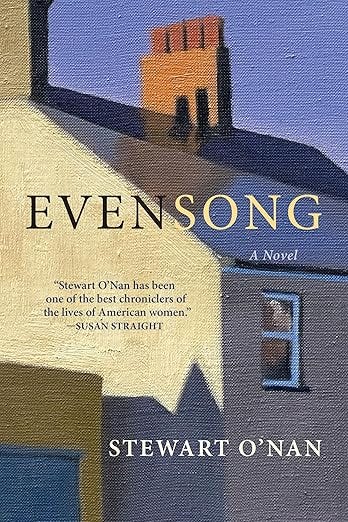
O’Nan’s great gift here is his exquisite attention to the inner lives of older women—their loyalties, irritations, regrets, humor, and deep moral seriousness. Nothing is exaggerated. Nothing is rushed. The novel is deeply Pittsburgh, not as scenery but as lived place: church, neighborhood rhythms, weather, and time itself shaping how these women care for one another and face what is ending and what still remains.
Evensong is a novel about friendship, responsibility, aging, and quiet devotion. It honors the ordinary work of showing up—for one another, for community, for life as it actually is. Spare, compassionate, and deeply humane, it lingers long after the last page.
A Brief Note on the Video Below
I recorded a short video this week that names something related to this moment—about limits, endings, and what it means to stay present when energy drops. If watching feels supportive, it’s below. If not, feel free to skip it. Either way, you’re welcome here.
For Tired Eyes
Notice the meeting of two gentle currents.
No force.
No urgency.
Just movement finding its way.
A Closing Blessing
May you be gentle with yourself in these final days of the year.
May your body be allowed to be tired without being judged.
May what has ended be honored, even if it did not end the way you hoped.
May you release the pressure to feel clear, grateful, or ready.
May you trust that not knowing is sometimes the most honest place to stand.
May you remember that care does not require certainty.
If you are carrying grief, may it be met with patience.
If you are carrying joy, may it be held without urgency.
If you are carrying both, may there be room for the complexity of that truth.
May you move into what comes next at the pace your life allows.
May you practice small endings with care, and small beginnings with humility.
And may whatever hope is possible right now—quiet, steady, or barely visible—be enough.
With love,
Joanne
this was lovely
Thank you for the beautiful blessing.